Demos / Order run
Sixlinked demoAutomation and IT
An order entered once. Seven steps follow, or it stops for a person.
A workflow for a wholesaler's trade orders. Each order from the website is taken through stock, the account check, the picking slip, the carrier booking, the invoice and the customer notice with nobody retyping it. A failed step is tried again. An order that needs a decision stops and waits for operations.
- Made-up business
- Harbour Lane Provisions
- Staff in the film
- Ben Castell, Operations
- Recorded
- 21 November 2026
What we measured.
Where it missed.
3 orders did not finish on their own: HL-24102, HL-24308 and HL-24339. Each was planned to finish untouched but met a carrier outage we planned to outlast all four tries. Each stopped, waited for a person to press Try again, and then finished. They are the 3 missing from 267 of 270 and from 57 of 60.
These figures are from the third scored run. The first two each found a bug: stock reserved twice for one order, and a crash when four threads drew picking slip images at once. Both were fixed and the whole plan of 300 orders was run again.
What it does not show
- No AI model is used. This demo is plain code.
- The website, carrier and accounts system are local stand-ins written for this test, not n8n, Zapier, Make, Power Automate or a live system.
- Faults were injected on a seeded plan; real outages are less tidy.
- One machine, one scored run (after two earlier runs that found bugs, reported in the README). Orders, customers and addresses are invented sample data.
What staff see.
Screens from the recording. Scroll sideways, or use the arrow keys.
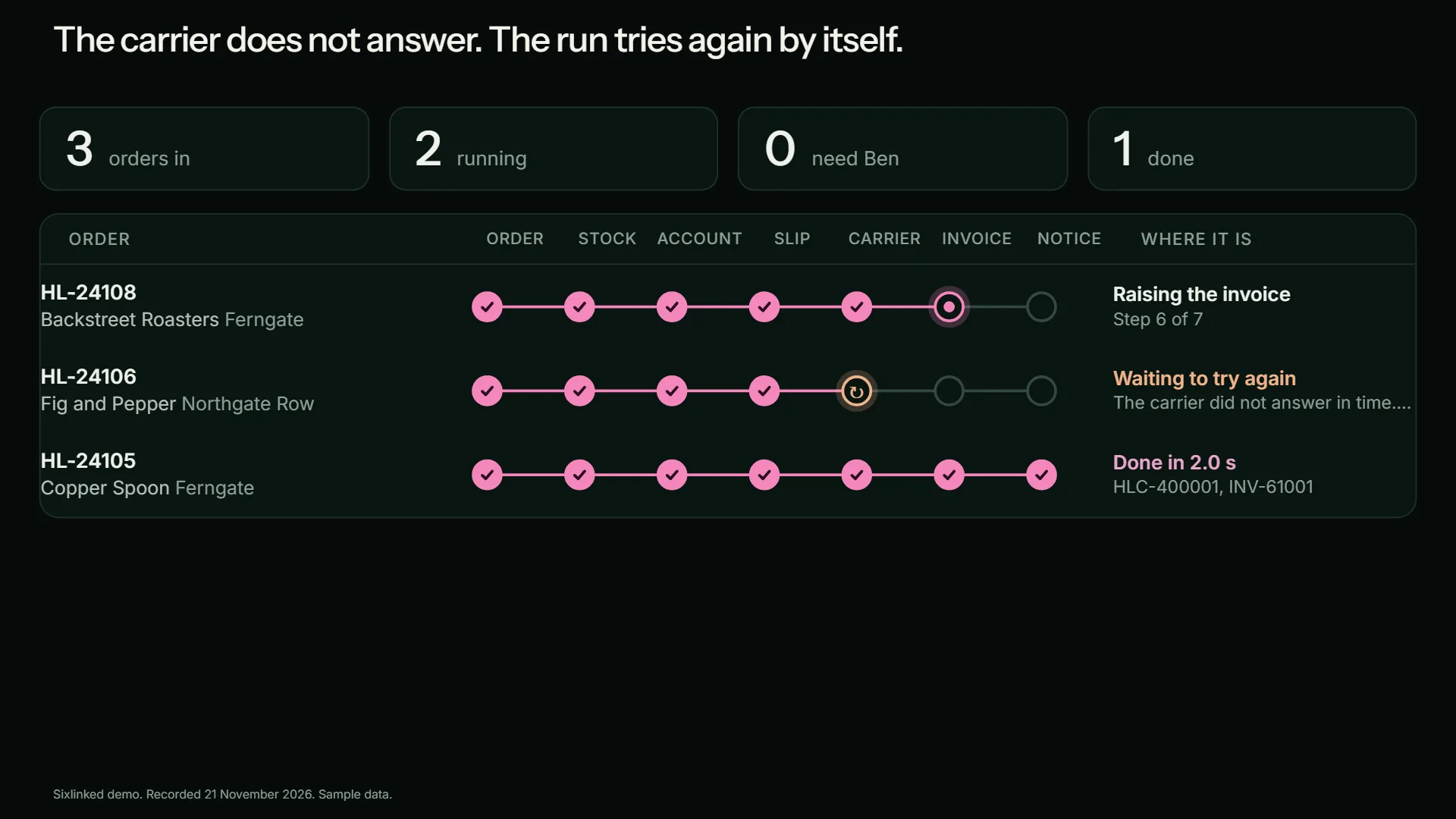
1The carrier does not answer. The run tries again by itself. 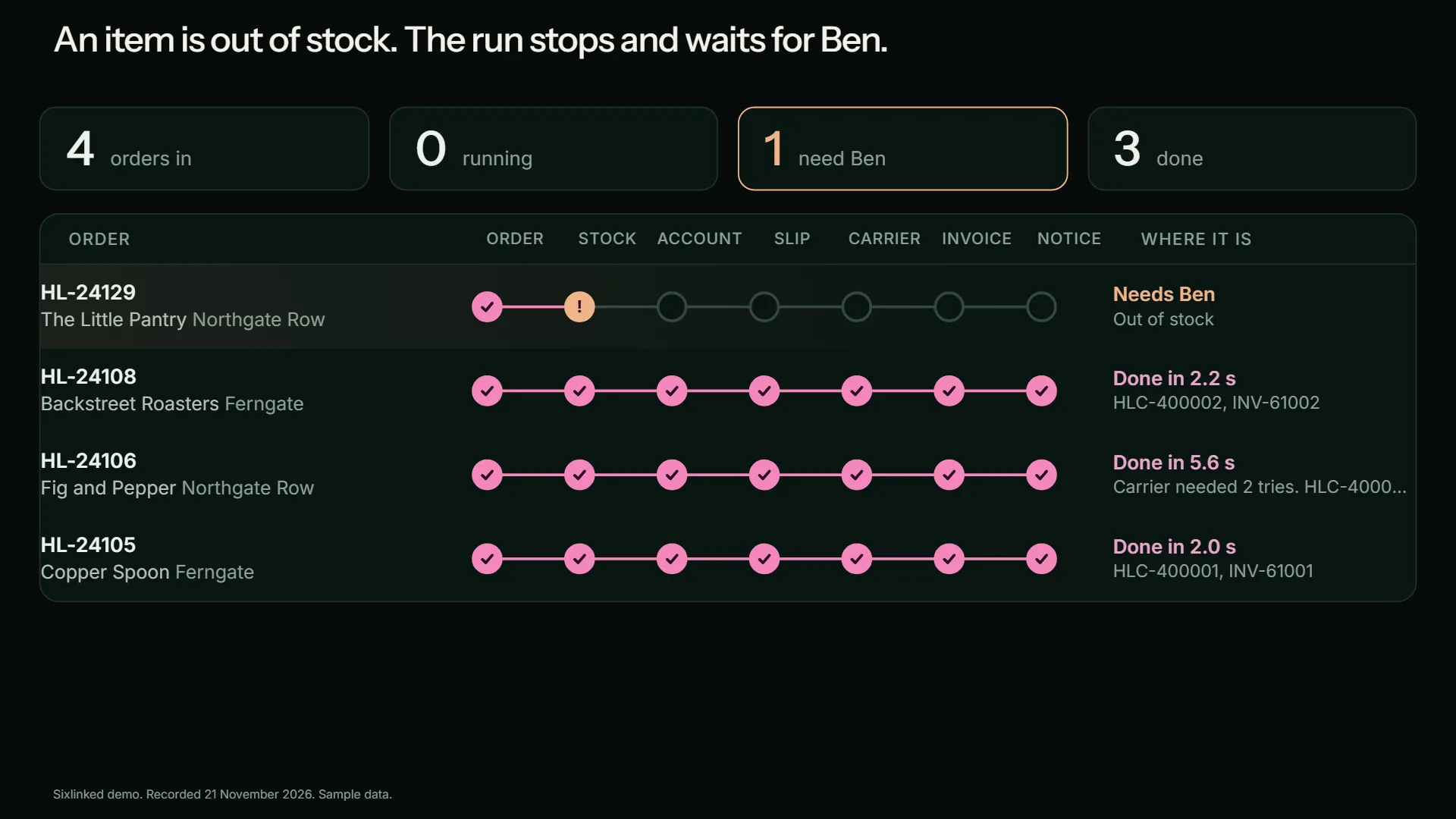
2An item is out of stock. The run stops and waits for Ben. 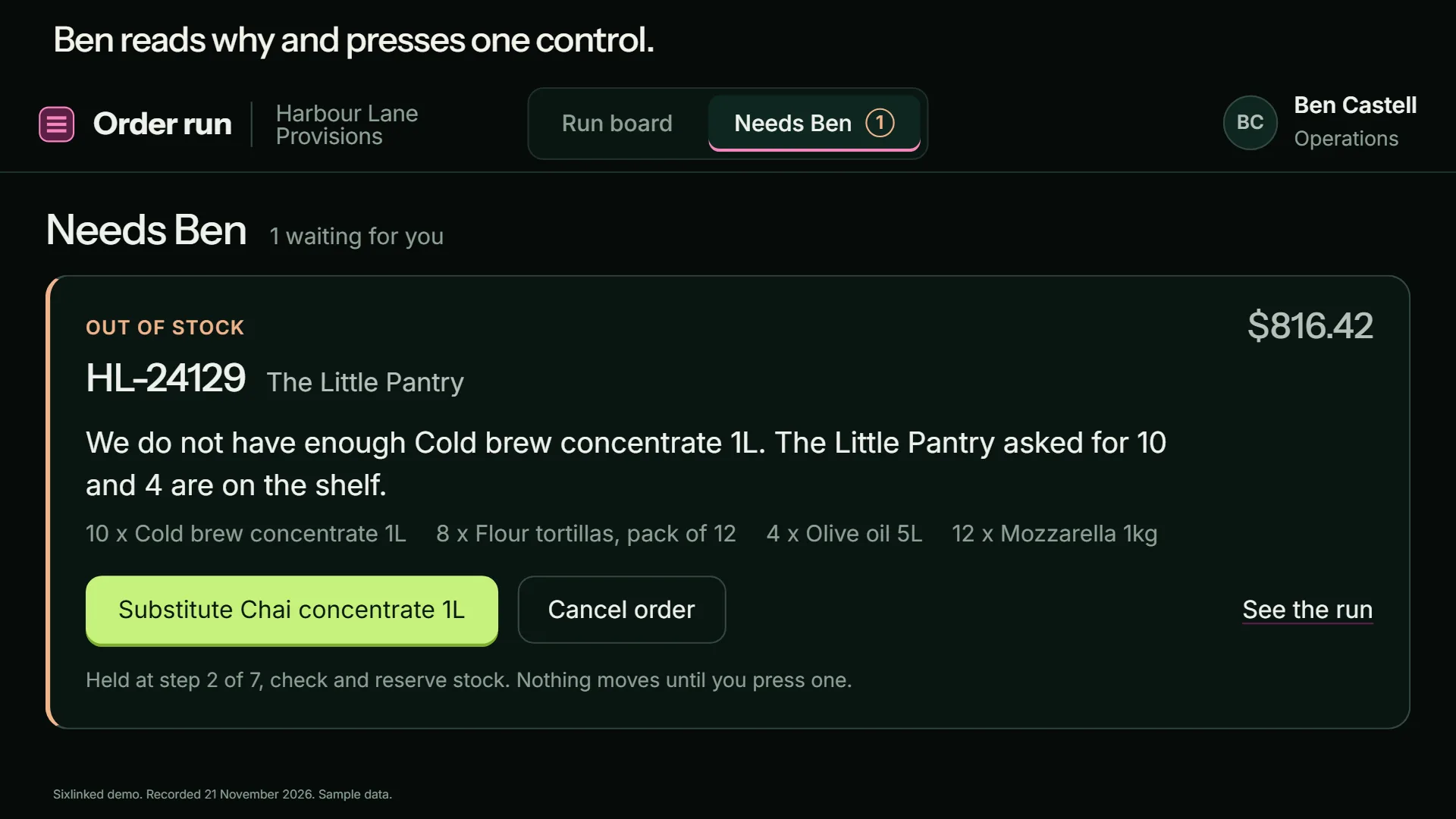
3Ben reads why and presses one control. 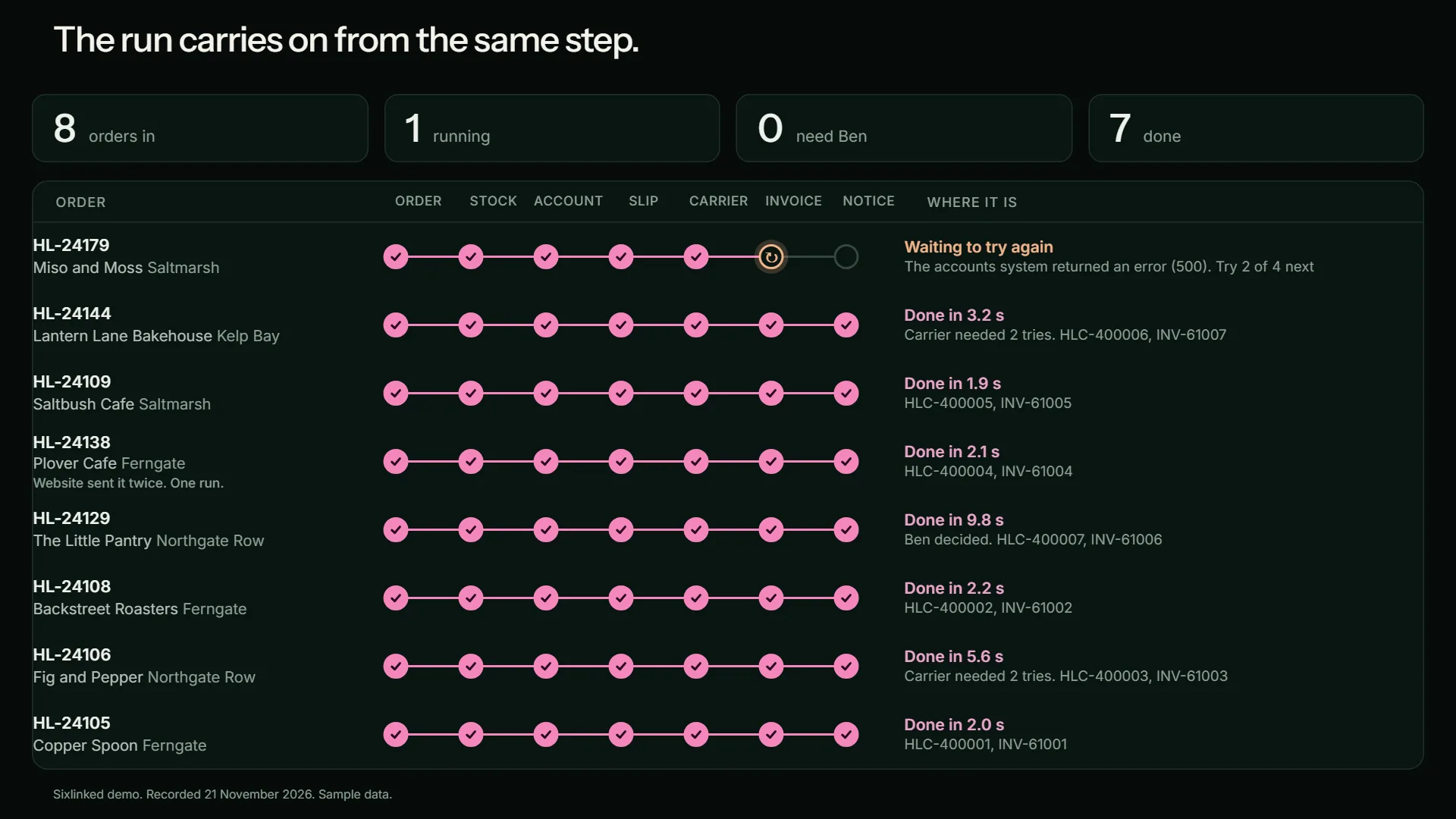
4The run carries on from the same step. 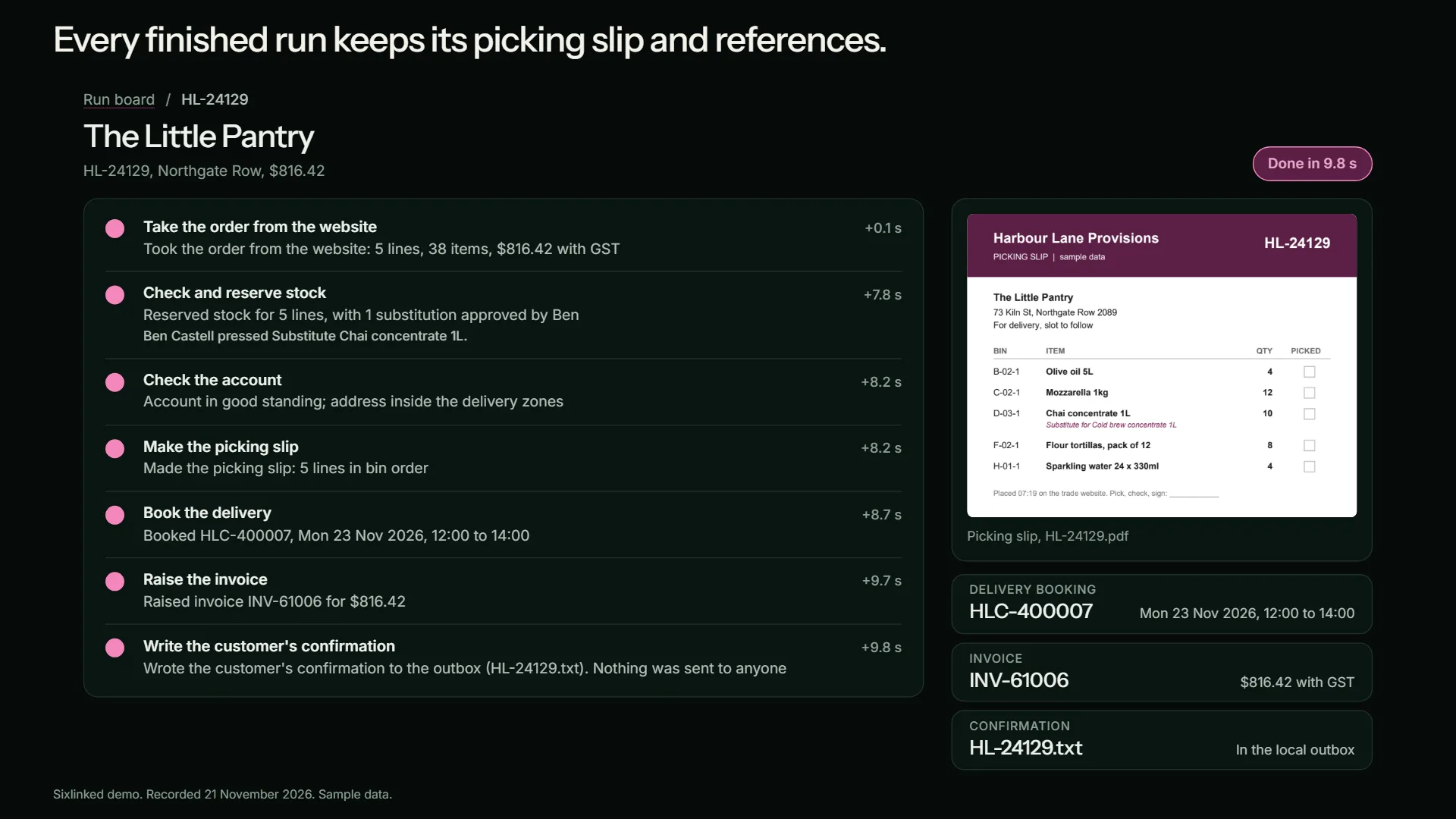
5Every finished run keeps its picking slip and references.
How it was built and tested.
- Each order becomes a run of seven durable steps kept in Postgres. A separate worker process claims runs with a short lease, so a killed worker's runs carry on from the step they were on.
- Every step has an idempotency key. Technical failures (time-out, 500, a reply lost after the request was accepted) are retried with doubling waits, four tries in all. Business exceptions (out of stock, credit hold, outside the delivery zones) are never retried: the run stops at Needs Ben with the reason and the choices.
- A frozen plan of 300 invented orders (30 webhooks delivered twice, injected faults on 60 runs, the worker killed 3 times, 30 business exceptions) was committed before scoring. Figures are counted from the carrier and accounts stand-ins' own tables, the database and the outbox folder.
- Two earlier scored runs exposed two bugs (a double stock reservation, and a crash when four threads rendered slip images at once). Both were fixed and the whole plan was re-run; all three runs are reported in the README.
About this recording
The film shows the recorded session at its real speed with a camera that zooms and a results card made from results.json. Ben's presses were scripted; every step, retry, hold, booking, invoice and slip is what the software did in that run. Stand-in replies were slowed to about half a second so the steps can be seen.
- Recorded
- 21 November 2026
- Model
- None. This demo is plain code.
- Real time of the session
- 33 seconds over 8 steps
Let's talk
Want an Automation and IT job like this?
Tell us what the work is today, who does it, and who should decide when something is doubtful.
You will get a reply by email from Matthew, the engineer who would do the work.
Your enquiry goes straight to our inbox. We use your details only to reply to you. Privacy